
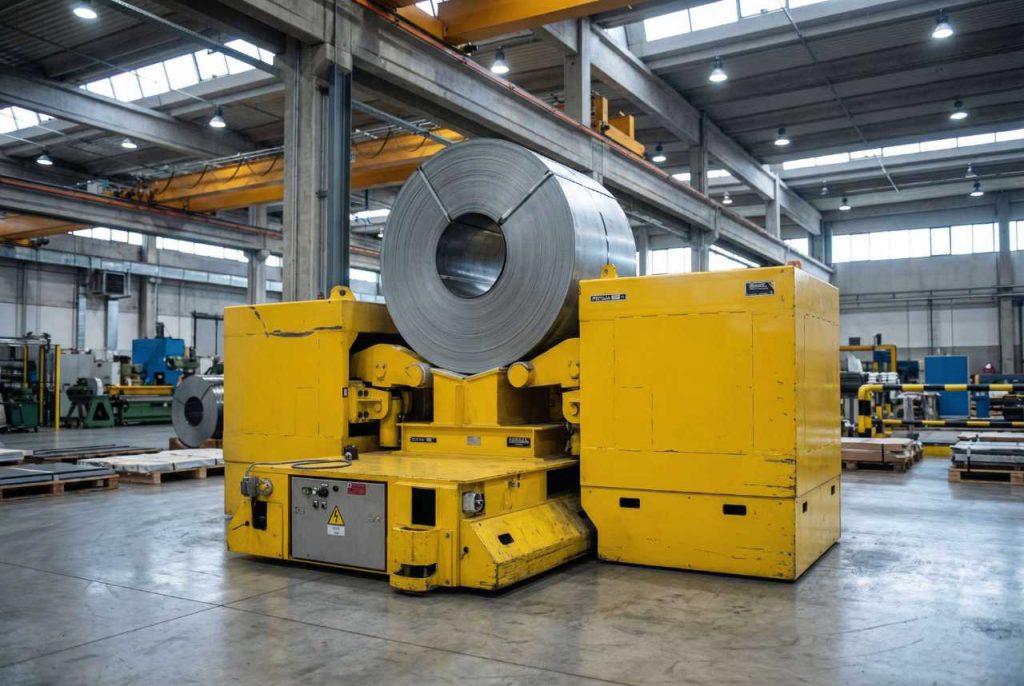
Steel coil handling represents one of the most demanding challenges in modern industrial environments. These cylindrical loads, often weighing several tons, require specialized transport solutions to ensure operational safety, material integrity, and production efficiency. Inadequate equipment selection not only increases operating costs but also exposes personnel to significant risks and may compromise the quality of the material being transported.
Steel coils are widely used across multiple industries, including steel manufacturing, automotive production, shipbuilding, and wind energy. Their cylindrical geometry, substantial weight, and surface sensitivity necessitate tailor-made handling systems specifically engineered for this application. Effective solutions must combine appropriate load capacity, secure support and stabilization systems, high maneuverability in confined spaces, and advanced control technologies.
Selecting the right coil handling equipment is therefore critical to optimizing internal logistics flows, minimizing risk, and preserving the value of the material throughout the production process.
Operational challenges in industrial coil transport
Handling metal coils within a production facility involves far more than simply moving a heavy load. It requires managing a series of technical and safety-critical variables that directly impact operational efficiency and risk exposure.
The cylindrical geometry of steel coils inherently creates instability. Even minor surface irregularities or abrupt movements can trigger uncontrolled rolling, posing significant risks to operators, equipment, and surrounding infrastructure. Weight adds another layer of complexity. Coils weighing 20 tons or more demand transport systems engineered not only for sufficient load capacity, but also for precise force distribution during acceleration, braking, and cornering.
Material integrity is another critical factor. Surface sensitivity means that scratches, dents, or edge deformations can compromise downstream processes, resulting in costly scrap, rework, or delivery delays. In many cases, damage occurs during internal handling rather than during production itself.
Spatial constraints further intensify these challenges. Narrow aisles between production lines, limited storage areas, and congested workspaces require exceptional maneuverability and positional control—capabilities that traditional lifting systems do not always provide.
The convergence of load instability, extreme weight, material sensitivity, and space limitations transforms coil handling into a high-risk, high-impact operation. Addressing these challenges requires careful planning, engineered solutions, and dedicated technologies specifically designed for safe and efficient coil transport.
Essential criteria for selecting coil handling equipment
Choosing the right equipment for coil transport begins with a thorough assessment of actual load requirements. It is not sufficient to consider only the maximum weight of a single coil. A proper evaluation must also account for safety margins, dynamic stresses during acceleration and braking, and potential load variations across different production scenarios. Undersized equipment not only compromises safety but also accelerates mechanical wear, leading to higher maintenance costs and reduced service life.
Maneuverability represents a second critical parameter. Precision positioning is often more time-consuming than the transport itself. Advanced steering technologies—such as omnidirectional drive systems or 360-degree rotation—enable lateral movement and zero-radius turning, significantly reducing maneuvering time in confined spaces. In high-density production environments, this translates directly into improved efficiency and smoother internal logistics flows.
Energy efficiency is another strategic consideration. Modern battery-powered systems equipped with regenerative braking can reduce energy consumption by up to 30% compared to traditional internal combustion or hydraulic solutions, lowering operating costs while supporting sustainability objectives.
Finally, customization should not be overlooked. Every production environment presents unique variables: coil diameters, loading heights, floor conditions, and handling frequency can vary considerably. Modular equipment with adaptable platforms and configurable support or gripping systems allows companies to tailor the solution to their operational requirements—optimizing performance without forcing production processes to conform to technical limitations.
Steel coil transport solutions: technologies and configurations
The current landscape of steel coil transport solutions includes a wide range of technological configurations designed to address diverse operational requirements.
Battery-powered transporters are the preferred choice for indoor applications, where zero emissions and low noise levels are essential. Modern lithium-ion battery systems provide extended operating autonomy and significantly reduced charging times, eliminating the need for spare battery sets and optimizing available storage space. In addition to improving sustainability performance, these systems contribute to lower operating costs and simplified maintenance management.
For applications demanding high power output and continuous operation, diesel or internal combustion engine solutions remain a viable option—particularly in outdoor environments or facilities with adequate ventilation. These systems offer a high power-to-weight ratio, making them suitable for transporting exceptionally large coils over long distances.
Automated solutions, such as AGVs (Automated Guided Vehicles) specifically designed for coil handling, are reshaping logistics flows in steel plants and service centers. These systems operate along predefined routes using magnetic guidance, laser navigation, or natural navigation technologies, and integrate seamlessly with warehouse management and production control software. The result is optimized routing, reduced idle time, and improved overall productivity by minimizing waiting periods between handling cycles.
Wheel configurations also play a critical role in long-term performance. Materials such as Vulkollan or high-performance polyurethane offer excellent wear resistance while protecting transit surfaces. Carefully engineered wheel geometries ensure even load distribution, preserving the structural integrity of industrial floors—even under intensive, long-term use.
Safety and control systems in cylindrical load handling
In coil handling operations, safety cannot be treated as an afterthought—it must form the foundation of the entire operational strategy. Advanced laser and ultrasonic sensors create virtual safety zones around the transporter, continuously detecting fixed and moving obstacles along its path. These systems respond within milliseconds, progressively reducing speed or triggering a full stop before contact occurs, thereby protecting personnel, equipment, and materials.
Safety bumpers serve as an additional protective layer. Positioned around the perimeter of the transporter, mechanical or pneumatic bumper systems activate an immediate emergency stop in the event of accidental impact. Preventing incidents that could disrupt production is not only a safety priority but also a critical factor in maintaining operational continuity.
Control systems have also reached a high level of sophistication. Intuitive operator interfaces with touchscreen displays and real-time visual feedback reduce training time and minimize the risk of human error. Remote-control options allow operators to manage movements from safe positions—particularly valuable in environments characterized by high temperatures, restricted visibility, or hazardous substances.
Compliance with CE directives and relevant EN standards ensures that equipment meets stringent safety requirements. This not only reduces legal exposure but also guarantees alignment with occupational health and safety regulations, supporting a safer and more reliable working environment.
Operational advantages of investing in specialized equipment
Investing in dedicated steel coil transport solutions delivers measurable returns that extend far beyond risk reduction. Operational efficiency improves significantly: a single operator can manage handling cycles that traditionally required multiple teams and complex coordination. In many cases, this results in throughput time reductions of up to 40%, freeing skilled personnel for higher value-added activities.
Maintenance costs often become an unexpected burden when non-specialized equipment is used for coil handling. Purpose-built transporters incorporate components engineered to withstand high cyclic stresses, reducing the frequency of maintenance interventions and extending overall service life. Unplanned downtime is not only a technical issue—it directly impacts annual productivity and profitability.
The flexibility of modular solutions further protects your investment. Adaptable load platforms, control system upgrades, and integration with emerging technologies can be implemented without replacing the entire machine. This ensures long-term scalability while preserving capital expenditure.
Environmental sustainability is now a strategic priority rather than an optional objective. Low-energy, zero local emission technologies contribute to carbon footprint reduction goals and align with increasingly stringent regulatory requirements and market expectations for responsible manufacturing practices.
Optimize coil handling with professional solutions
Effective steel coil handling requires a strategic approach that integrates advanced technology, certified safety systems, and application-specific configurations. Every element—from load capacity sizing to control architecture—directly influences plant productivity and operator safety.
Specialized solutions should not be viewed as a cost, but as a long-term investment that generates measurable returns through improved efficiency, reduced scrap rates, enhanced safety, and optimized workforce utilization.
Morello designs and manufactures industrial transporters for heavy-duty applications capable of addressing the most demanding coil handling challenges. With decades of experience in developing customized equipment for multi-ton capacities, Morello’s solutions combine advanced safety technologies, energy efficiency, and exceptional maneuverability.
Discover how our specialized handling systems can transform your internal logistics processes—delivering reliable performance, operational continuity, and full regulatory compliance in every industrial environment.