
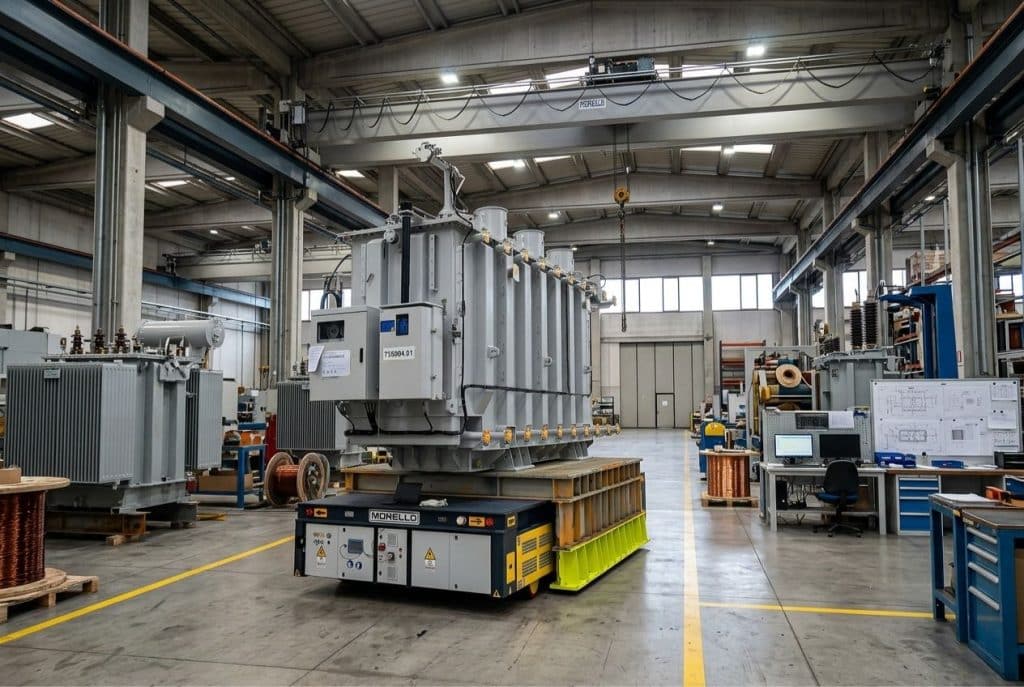
Transporting a power transformer is not a standard logistics operation. These are massive, high-value assets — often weighing between 30 and several hundred tons — whose safe and precise movement directly affects the continuity of energy infrastructure and industrial production. A single handling error can result in irreversible damage to the equipment, costly project delays, and serious safety risks for the personnel involved.
Power transformer transportation requires purpose-built solutions: machinery engineered to manage extreme loads with millimeter-level precision, advanced safety systems, and the flexibility to operate in complex industrial environments. Generic transport methods simply cannot meet these demands.
Morello designs and manufactures heavy-duty self-propelled transfer carts and handling equipment specifically built for these challenges. With decades of experience serving energy, industrial, and infrastructure sectors across the globe, Morello delivers the engineering reliability that transformer handling demands.
The real complexity behind power transformer transportation
Power transformers are among the most critical and expensive components in any energy infrastructure. Their weight alone — often ranging from 30 to several hundred tons — makes every movement a high-stakes engineering challenge. But weight is only part of the equation. These units are structurally sensitive: internal windings, cooling systems, and insulation components can sustain permanent damage from vibration, sudden jolts, or uneven load distribution during transit.
Beyond the physical fragility, the environments in which transformers must be moved add further complexity. Manufacturing facilities, substations, and testing yards often feature narrow corridors, uneven flooring, tight turning radiuses, and limited overhead clearance. In many cases, the transformer must transition between indoor and outdoor surfaces, requiring equipment that can adapt seamlessly to both conditions.
What makes power transformer transportation genuinely demanding is the combination of all these factors simultaneously: extreme weight, structural sensitivity, environmental constraints, and zero tolerance for error. This is not a task that can be approached with improvised solutions.
Why standard handling methods fall short
Cranes, forklifts, and standard flatbed trailers are commonly available in industrial settings, and it might seem logical to rely on them for transformer handling. In practice, however, these methods introduce risks that purpose-built equipment is specifically designed to eliminate.
Cranes, for instance, require significant vertical clearance and introduce dynamic load swings that are difficult to control with precision. A suspended transformer is vulnerable to oscillation, which can cause internal damage even without visible external impact. Standard trailers, on the other hand, lack the fine positioning capabilities needed to place a transformer accurately on its foundation or testing platform.
Forklifts present their own limitations: their load capacity rarely meets the requirements of high-tonnage transformers, and their rigid steering geometry makes precise maneuvering in confined spaces nearly impossible. When the cost of the equipment being moved runs into millions of dollars, relying on inadequate handling tools is simply not a viable option.
Key features of purpose-built transformer transport equipment
Specialized transfer carts designed for transformer handling share a set of core engineering characteristics that directly address the challenges outlined above:
- Hydraulic lifting systems that allow millimeter-level height adjustment, enabling smooth and controlled placement on foundations or test benches without vibration.
- High-capacity structural frames validated through finite element analysis (FEA), ensuring the cart maintains integrity under both static and dynamic extreme loads.
- Omnidirectional drive systems with ±90° or full 360° crab movement, allowing navigation in tight factory layouts where conventional vehicles cannot operate.
- Integrated safety sensors — including laser scanners, ultrasonic detectors, and mechanical bumpers — that automatically reduce speed or halt movement when obstacles are detected.
- Flexible power configurations, ranging from battery-electric to diesel-hydraulic, to suit both indoor air quality requirements and outdoor operational demands.
These features work together to create a handling system that is not only powerful, but repeatable and predictable — essential qualities when moving assets of this value and sensitivity.
Precision, safety, and control: what heavy-duty handling really means
In transformer handling, precision is not a luxury — it is a functional requirement. Placing a transformer even a few centimeters off its designated position can compromise alignment with electrical connections, delay commissioning, or require additional handling cycles that multiply risk exposure.
Advanced transfer carts address this through multi-axis control systems that allow operators to make fine positional corrections in real time, either through remote control interfaces or fully autonomous navigation protocols. The operator maintains complete visibility and authority over every movement, with the system acting as a safety layer rather than a constraint.
Safety, in this context, extends beyond obstacle detection. It includes load stability monitoring, anti-tip mechanisms, and surface condition compensation — systems that continuously assess and respond to variables that a human operator alone cannot reliably track. When a transformer worth millions of dollars is in motion, this level of active oversight is what separates professional handling from acceptable risk.
Choosing the right equipment for transformer handling operations
Selecting the appropriate transport solution for a specific transformer handling operation requires a structured evaluation of several interdependent factors. The load capacity of the cart must exceed the transformer’s weight with an adequate safety margin. The drive system must match the surface conditions and spatial constraints of the facility. The lifting mechanism must be compatible with the transformer’s base geometry and the height requirements of its destination.
Equally important is the level of customization available from the manufacturer. No two transformer handling scenarios are identical, and a supplier capable of engineering a solution around the specific operational requirements — rather than offering a catalogue product and hoping it fits — provides a fundamentally different level of reliability.
Morello has built its international reputation precisely on this capacity for tailored engineering. From self-propelled platform trucks to fully automated AGV systems, each solution is designed around the real constraints of the customer’s environment, ensuring that power transformer transportation is executed with the precision, safety, and efficiency that these critical assets demand.
Moving transformers safely: where engineering meets responsibility
Every power transformer transportation operation carries with it a weight that goes beyond tonnage. It carries the responsibility of protecting a critical asset, ensuring operator safety, and maintaining project timelines that often have no margin for error. The difference between a successful move and a costly incident lies entirely in the quality of the equipment and the engineering behind it.
Morello designs and manufactures heavy-duty self-propelled transfer carts and specialized handling equipment built to meet exactly these demands. With a global track record spanning multiple industries and continents, Morello combines Italian engineering precision with the flexibility to deliver fully customized solutions for even the most complex handling scenarios.
If your operation involves the movement of high-tonnage transformers, explore Morello’s range of transporter carts and find the solution engineered for your specific requirements.