
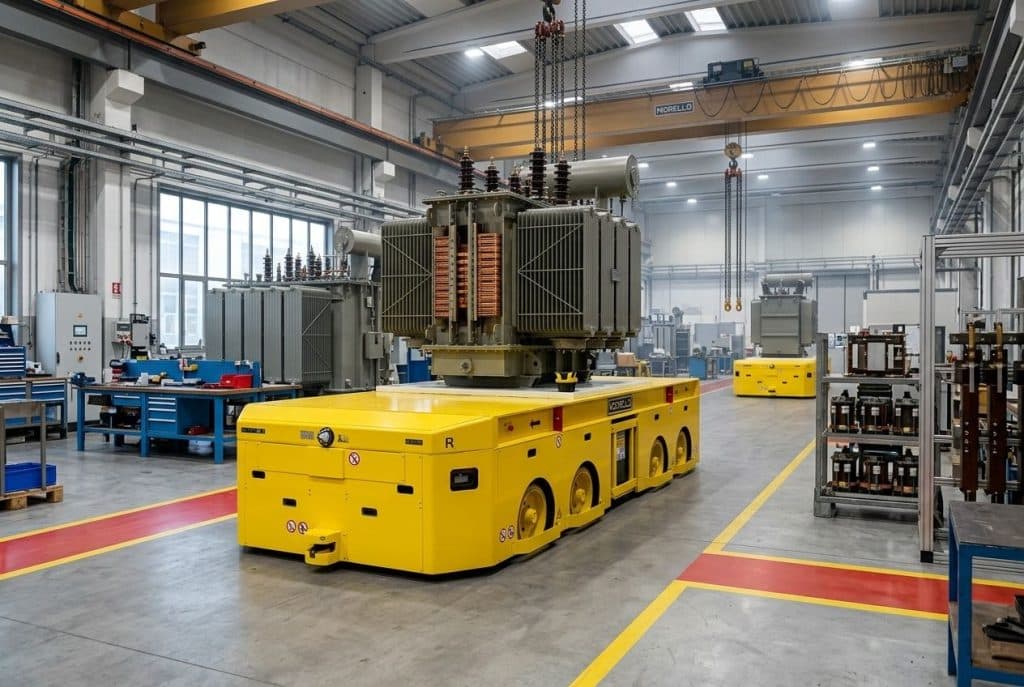
In the energy sector, moving heavy and oversized equipment is one of the most demanding logistical challenges a facility can face. Whether it involves transporting power transformers, handling battery energy storage system (BESS) containers, or positioning critical components within substations and power plants, standard material handling equipment simply cannot meet the requirements. Heavy-duty transfer carts are purpose-engineered machines designed to move extreme loads with precision, stability, and complete operational safety.
Morello specializes in the design and manufacturing of high-capacity self-propelled transfer carts and industrial handling solutions tailored to the most demanding environments. From wind energy installations to large-scale power infrastructure projects, Morello’s equipment delivers the reliability and load capacity that energy sector operations require.
Why the energy sector demands heavy-duty transfer carts
The energy sector operates under conditions that push material handling to its absolute limits. Power plants, transformer substations, wind farms, and battery energy storage facilities all share a common challenge: moving extraordinarily heavy, oversized, and often fragile equipment through complex environments where precision is not optional — it is essential.
Think about a large power transformer. It can weigh anywhere between 50 and several hundred tons, and a single mishandled movement can result in catastrophic damage, costly delays, or serious safety incidents. Standard forklifts or conventional industrial trucks are simply not built for this level of responsibility. Heavy-duty transfer carts for the energy sector exist precisely because these operations demand a different class of engineering — machines that combine raw load capacity with fine-tuned control, stability on uneven ground, and the ability to operate safely in environments that may include explosive atmospheres or extreme weather conditions.
Beyond the technical requirements, there is also a business case. Downtime in energy infrastructure is expensive. Every hour a transformer sits uninstalled or a BESS unit waits to be positioned translates directly into project delays and financial loss. The right transfer cart solution eliminates bottlenecks, reduces crane dependency, and keeps critical timelines on track.
Key applications: from transformer handling to BESS container transport
The range of applications for heavy-duty transfer carts in the energy sector is broader than many expect. While transformer transport is perhaps the most well-known use case, modern energy infrastructure generates a variety of handling challenges that require equally specialized solutions.
- Power transformer transport: Moving transformers within substations or from delivery points to installation sites, often requiring hydraulic lifting for precise vertical positioning.
- BESS container handling: Battery energy storage system containers are large, heavy, and increasingly common in renewable energy projects. Their modular nature demands a transfer system capable of repetitive, accurate positioning.
- Wind turbine component movement: Nacelles, hubs, and generator assemblies require ground-level transport solutions that can handle irregular load geometries.
- Power plant maintenance operations: Internal movement of turbine components, cooling systems, and heavy machinery during scheduled maintenance shutdowns.
- Substation equipment installation: Positioning switchgear, reactors, and other high-voltage equipment with millimeter-level accuracy.
Each of these scenarios presents unique constraints — from floor load capacity and available space to the sensitivity of the cargo itself. A transfer cart designed for one application may be entirely unsuitable for another, which is why understanding the full spectrum of energy sector needs is the starting point for any effective handling solution.
Engineering features that make the difference in high-load operations
When loads reach tens or hundreds of tons, every engineering decision matters. The performance gap between a well-engineered heavy-duty transfer cart and a generic solution becomes immediately apparent under real operating conditions.
The most critical technical features of transfer carts for the energy sector include robust steel platform construction capable of distributing load evenly across the entire deck, independent wheel group steering for navigating tight spaces and complex site layouts, and variable-speed drive systems that allow operators to move massive loads with smooth, controlled acceleration. Hydraulic lifting decks add another dimension of capability, enabling precise vertical adjustment during transformer installation without the need for additional crane operations.
Power source selection also plays a significant role. Battery-powered electric transfer carts are increasingly preferred in enclosed facilities and environmentally sensitive areas, while diesel-powered self-propelled platforms remain the standard for outdoor and remote site operations. In environments where explosive gases or flammable materials may be present, explosion-proof configurations are not a luxury — they are a regulatory requirement.
Remote control operation is another feature that directly impacts safety, allowing operators to manage the cart’s movement from a safe distance while maintaining full visibility of the load and the surrounding environment.
Custom solutions vs. off-the-shelf equipment: what energy projects really need
One of the most common mistakes in energy project planning is assuming that a catalogued, ready-to-ship transfer cart will meet the specific demands of the job. In reality, the variables involved in energy sector operations — load weight and geometry, ground conditions, available headroom, access routes, and safety regulations — are rarely identical from one project to the next.
Off-the-shelf equipment offers speed of delivery and lower upfront costs, but it often requires workarounds that compromise efficiency or safety. A transformer with an unusual weight distribution, for example, may demand a custom deck configuration or a specific hydraulic lifting arrangement that no standard product can provide.
Custom-engineered transfer carts, on the other hand, are developed through a detailed analysis of the actual operational context. This means load distribution studies, site surveys, workflow mapping, and close collaboration between the engineering team and the end user. The result is a machine that fits the project — not the other way around. For large-scale, high-value energy infrastructure, this investment in precision engineering pays for itself many times over by eliminating risk and maximizing operational efficiency.
How Morello designs transfer carts for energy sector challenges
Morello brings decades of experience in high-capacity material handling to the energy sector, with a track record that spans power generation, wind energy, and large-scale infrastructure projects across multiple continents. Based in Piedmont, Italy, and operating globally, Morello approaches every project with the same principle: the equipment must be built around the challenge, not the other way around.
The design process begins with a thorough understanding of the load, the site, and the operational workflow. Morello’s engineering team works directly with clients to develop transfer cart configurations that address every constraint — from ground bearing capacity and available maneuvering space to electrical safety standards and environmental conditions. Whether the requirement is a battery-powered cart for indoor substation work or a high-tonnage self-propelled platform for outdoor transformer transport, each solution is validated through structural analysis before production begins.
Morello also offers rental and ready-to-deliver options for projects with tighter timelines, ensuring that even urgent energy sector operations have access to professional-grade handling equipment.
Moving energy infrastructure forward, one load at a time
The energy sector leaves no room for handling errors. When the equipment being moved weighs hundreds of tons and represents critical national infrastructure, the transfer cart solution must be engineered to perform flawlessly — every single time. From transformer substations to wind farms and BESS installations, heavy-duty transfer carts are the backbone of safe, efficient, and timely project execution.
Morello has built its reputation by delivering exactly this level of reliability to energy operators and project managers worldwide. With custom engineering, global reach, and a product range that covers every high-capacity handling need, Morello is the partner that energy sector professionals trust when the stakes are highest.
Ready to move your next energy project forward? Explore Morello’s battery-powered transfer carts and find the right solution for your operation.