
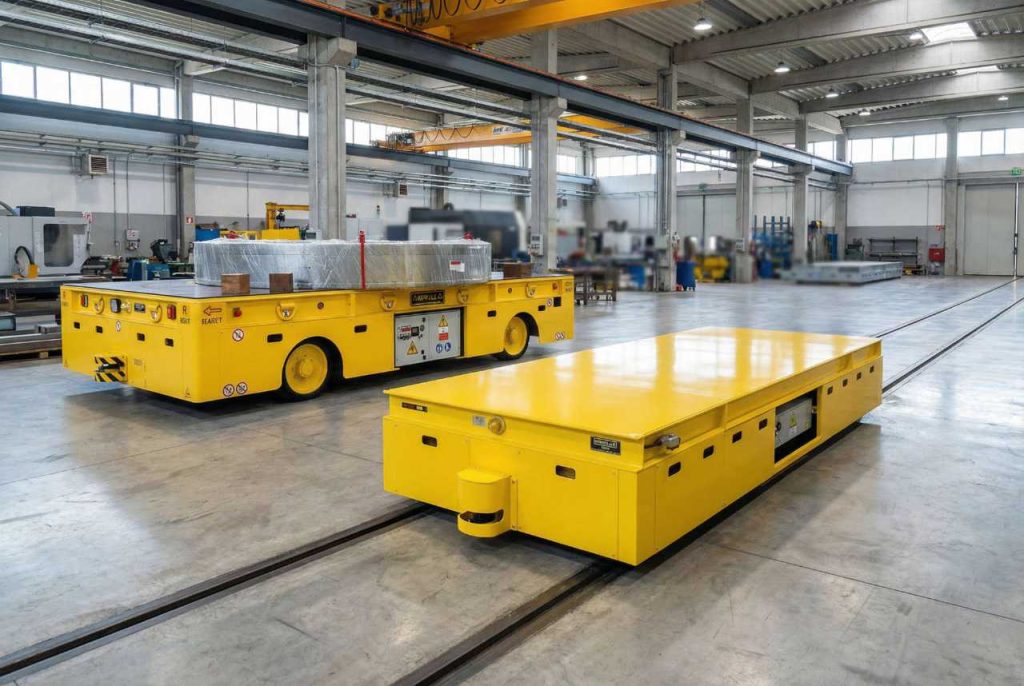
Moving heavy loads efficiently and safely is a fundamental challenge in modern industrial operations. Whether you’re managing a steel mill, aerospace manufacturing facility, or wind energy component production, the choice between rail-guided and trackless material handling systems directly impacts your operational efficiency, safety standards, and bottom line.
Industrial transfer carts have evolved into sophisticated solutions capable of transporting loads weighing hundreds of tons across production floors, assembly areas, and storage facilities. Understanding the distinct advantages and limitations of each system type is essential for making an informed investment decision. Rail-based carts offer unmatched stability and load capacity for fixed-route applications, while trackless solutions provide flexibility and adaptability for dynamic production environments.
The emergence of automated and autonomous systems has further expanded the possibilities, introducing smart logistics capabilities that integrate seamlessly with modern manufacturing processes. This comprehensive analysis examines the core differences between industrial transfer cart types, helping you identify the optimal material handling solution for your specific operational requirements and long-term business objectives.
Understanding industrial transfer cart fundamentals
Industrial transfer carts represent the backbone of heavy-duty material handling in manufacturing environments where conventional forklifts and conveyors fall short. These specialized vehicles are engineered to transport loads ranging from several tons to over 400 tons, making them indispensable in sectors like steel production, aerospace assembly, shipbuilding, and wind turbine manufacturing. But what exactly defines an industrial transfer cart, and why has it become such a critical component in modern production facilities?
At their core, transfer carts are motorized platforms designed to move heavy materials, components, or finished products across production floors with precision and safety. Unlike standard material handling equipment, these carts are built to withstand extreme weights while maintaining operational reliability in demanding industrial environments. The fundamental distinction among industrial transfer cart types lies in their guidance system: some operate on fixed rail tracks, while others move freely across flat surfaces without physical constraints.
The choice between rail-guided and trackless material handling solutions isn’t merely a technical preference—it fundamentally shapes your facility’s workflow, spatial utilization, and future scalability. Rail systems excel in repetitive, high-capacity transport along predetermined paths, while trackless solutions offer adaptability for operations requiring multi-directional movement and route flexibility. Understanding these foundational differences helps you align your material handling strategy with your operational reality, ensuring that your investment delivers measurable returns in productivity, safety, and cost efficiency.
Rail transfer carts: precision and power for fixed-route operations
When your production process demands moving massive loads along a specific, repeatable path, rail transfer carts deliver unmatched performance and reliability. These systems operate on dedicated tracks installed directly into your facility floor, creating a guided pathway that ensures consistent positioning and exceptional load stability. The rail-based approach eliminates navigational uncertainty, making these carts ideal for applications where precision placement is critical—such as positioning aircraft fuselage sections for assembly or transporting molten metal ladles in foundries.
The load capacity of rail transfer carts is truly impressive, with systems routinely handling 100 to 400 tons and specialized configurations capable of even greater weights. This extraordinary capacity stems from the distribution of weight across the rail structure, which provides superior support compared to wheel-based systems on open floors. Steel mills rely heavily on these carts to move coils, slabs, and finished products through multiple processing stages, while shipyards use them to transport hull sections weighing hundreds of tons with millimeter-level accuracy.
Safety is inherently built into rail systems through their constrained movement pattern, which eliminates the risk of unintended deviation or collision with obstacles outside the designated path. Modern rail transfer carts incorporate advanced safety features including emergency stop systems, overload protection, and collision avoidance sensors that monitor the track ahead. The primary consideration with rail systems is their fixed infrastructure requirement—once installed, the route is permanent, making them best suited for operations with stable, long-term production layouts where the investment in track installation delivers sustained value over years of continuous operation.
Trackless material handling: flexibility meets mobility
What if your production environment requires moving heavy loads to different destinations based on changing production schedules or seasonal demands? Trackless transfer carts, also known as free-roaming or non-rail systems, provide the solution by operating independently on flat concrete floors without any fixed guidance infrastructure. This fundamental difference opens up possibilities that rail systems simply cannot offer: multi-destination flexibility, route adaptability, and the ability to reconfigure material flow as your operations evolve.
Trackless carts utilize various power sources including lithium battery systems, diesel engines, or cable-fed electric motors, each offering distinct advantages depending on your operational environment. Battery-powered models have gained significant traction due to their zero emissions, quiet operation, and elimination of trailing cables that can create safety hazards or movement restrictions. These systems excel in facilities where loads need to be transported between different production areas, storage zones, or assembly stations without following a predetermined path.
The operational flexibility of trackless material handling comes with important considerations. Floor quality becomes critical—surfaces must be level, smooth, and capable of supporting concentrated wheel loads without degradation. Load capacities, while substantial, typically range lower than rail systems, with most trackless carts handling between 1 and 150 tons effectively. However, this capacity range covers the vast majority of industrial applications, from moving automotive components and aerospace subassemblies to transporting wind turbine nacelles and military equipment. The absence of track installation also means lower initial infrastructure costs and faster deployment, allowing you to implement material handling solutions without extensive facility modifications or extended downtime during installation.
Autonomous and automated transfer systems: the smart factory evolution
The integration of artificial intelligence, sensor technology, and advanced control systems has transformed industrial transfer carts from manually operated vehicles into intelligent logistics platforms. Autonomous transfer carts represent the cutting edge of material handling, capable of navigating complex production environments, optimizing routes in real-time, and coordinating with other equipment without human intervention. Are you ready to explore how these systems are reshaping manufacturing efficiency?
Autonomous systems employ sophisticated sensor arrays including laser scanners, ultrasonic detectors, and vision systems that create a comprehensive environmental map, detecting obstacles, personnel, and other equipment with remarkable precision. These carts can execute complex maneuvers such as 360-degree rotation, crab steering for lateral movement, and multi-directional travel that would be impossible or impractical with manual operation. The result is optimized material flow that adapts dynamically to production demands, reducing idle time and maximizing throughput.
Integration with manufacturing execution systems and enterprise resource planning platforms enables autonomous carts to receive instructions directly from production scheduling software, creating a seamless connection between digital planning and physical material movement. This Industry 4.0 compatibility transforms transfer carts from isolated pieces of equipment into nodes within an intelligent production network. Safety reaches new levels through redundant sensor systems that continuously monitor the operating environment, automatically reducing speed or stopping when personnel enter predefined safety zones. The investment in autonomous systems delivers returns through reduced labor requirements, improved utilization rates, and the elimination of human error in material handling operations—particularly valuable in facilities operating multiple shifts or seeking to optimize workforce allocation toward higher-value tasks.
Selecting the right solution for your material handling needs
Choosing between industrial transfer cart types requires a systematic evaluation of your operational requirements, facility characteristics, and strategic objectives. Start by analyzing your load specifications: weight, dimensions, and handling frequency. Loads exceeding 150 tons or requiring extreme precision along a fixed route strongly favor rail systems, while operations with varied destinations and moderate weights benefit from trackless flexibility.
Consider your facility layout and future adaptability needs. If your production process is mature and stable, with established material flow patterns unlikely to change, the higher load capacity and stability of rail transfer carts justify the infrastructure investment. Conversely, if you anticipate production line reconfigurations, product mix changes, or facility expansions, trackless systems preserve operational flexibility without requiring costly track modifications.
Budget considerations extend beyond initial equipment costs to include installation, maintenance, and operational expenses. Rail systems demand significant upfront investment in track installation but offer lower per-cycle operating costs for high-volume applications. Trackless carts require minimal installation but may incur higher energy costs depending on power source selection. Autonomous systems command premium pricing but deliver measurable returns through labor reduction and efficiency gains in facilities with sufficient operational scale to justify the investment.
Safety requirements and regulatory compliance also influence selection. Industries with explosive atmospheres or hazardous materials may require explosion-proof specifications available in both rail and trackless configurations. Finally, consider your workforce capabilities and training requirements—simpler manual systems may be appropriate for operations with established material handling teams, while autonomous solutions suit facilities pursuing digital transformation and workforce optimization strategies. The right choice aligns your material handling capabilities with your operational reality and business objectives, creating a foundation for sustained competitive advantage.
Choosing your industrial material handling partner
The decision between rail and trackless material handling systems shapes your operational capabilities for years to come, making it essential to work with a partner who understands both the technical requirements and the strategic implications of your choice. Whether you need the robust capacity of rail transfer carts, the flexibility of trackless solutions, or the intelligence of autonomous systems, selecting equipment engineered for reliability and performance is paramount.
Morello has built its reputation delivering customized material handling solutions to multinational corporations across aerospace, military, renewable energy, and heavy manufacturing sectors worldwide. From Italian engineering excellence to global project execution, Morello designs and manufactures transfer carts capable of moving loads exceeding hundreds of tons with precision and safety. Each system is tailored to your specific operational requirements, facility constraints, and performance objectives.
Ready to optimize your material handling operations? Explore Morello’s transfer carts and discover how the right industrial transfer cart solution transforms productivity, enhances safety, and supports your long-term operational goals with proven engineering and dedicated support.