
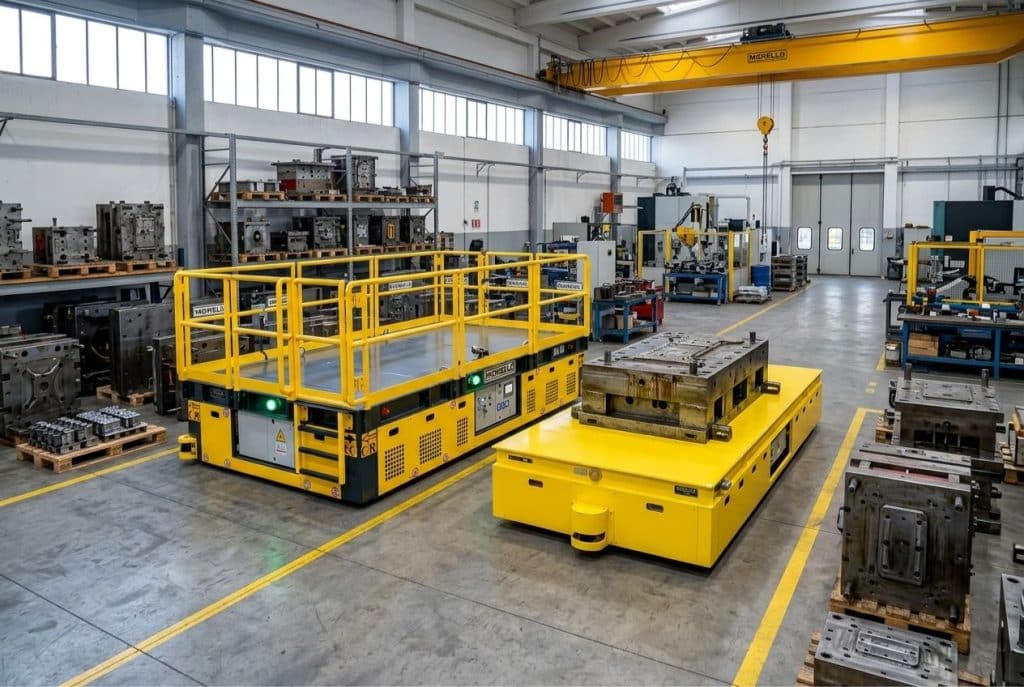
Moving stamping dies and injection molds inside a press shop is one of the most demanding — and potentially hazardous — tasks in heavy industrial manufacturing. When a single tool can weigh dozens of tons, every changeover becomes a critical operation where precision, speed, and safety must work together without compromise.
A die change cart is the purpose-built solution that makes this possible, replacing slow overhead cranes and manual handling with a controlled, mechanical transfer process that protects both operators and expensive tooling. A heavy-duty mold transfer cart extends this capability to the most extreme load conditions, handling tools that standard equipment simply cannot manage.
Understanding how these systems work — and what to look for when selecting one — is the first step toward faster changeovers, fewer accidents, and longer tool life in any stamping, punching, or molding operation.
What is a die change cart and why does it matter in press shops
A die change cart is a mobile or rail-mounted platform engineered specifically to transport, position, and exchange stamping dies, press tools, and injection molds within industrial manufacturing environments. Unlike general-purpose forklifts or overhead cranes — which introduce significant risk when handling tools that can weigh several tons — a die change cart is purpose-built for this exact task, combining controlled movement, precise alignment, and integrated safety systems in a single unit.
Why does this matter? Consider a typical automotive press shop running multiple die changeovers per shift. Every minute spent waiting for a crane, repositioning a misaligned tool, or managing a near-miss incident is a minute of lost production. Multiply that across dozens of changeovers per week, and the impact on uptime, costs, and operator safety becomes impossible to ignore. A dedicated die transfer solution eliminates these bottlenecks by standardizing and mechanizing the entire exchange process — making changeovers faster, safer, and far more repeatable than any manual approach could achieve.
Load capacities, configurations, and key functional components
Modern die and mold transfer carts cover an exceptionally wide performance range, from compact units handling around 4,000 kg for medium-sized presses, all the way to heavy-duty mold transfer cart configurations capable of managing loads between 50 and 100 tons for the largest stamping and casting operations. The right configuration depends entirely on the tools being handled and the layout of the production environment.
Regardless of capacity, most high-performance die carts share a common set of functional components that define their capability:
- Electro-hydraulic lifting platform: allows vertical alignment between the cart deck and the press bolster, compensating for floor level differences and pit configurations.
- Push-pull system: a powered mechanism that moves the die onto or off the cart and into the press table without requiring manual effort, operating at controlled feed rates with selectable creep speed for fine positioning.
- Ball bars and load rollers: hydraulic ball-transfer elements or fixed rollers that reduce friction during loading and unloading, preventing damage to die shoes and press bolsters.
- Docking bars and alignment guides: ensure repeatable mechanical connection between cart and press, eliminating lateral drift and reducing misalignment forces.
- Safety circuits and interlocks: prevent cart movement or lifting under unsafe conditions, with remote pendant or wireless controls that keep operators outside hazard zones.
Double-cart configurations — such as DUO systems with two independent push-pull units — are also available for handling very long dies or servicing two presses simultaneously, adding further flexibility to high-volume operations.
How a heavy-duty mold transfer cart transforms changeover operations
The operational impact of a heavy-duty mold transfer cart goes well beyond simply moving a tool from point A to point B. When properly integrated into a press shop workflow, these systems fundamentally change how changeovers are planned, executed, and measured. What once required a team of operators, a crane booking, and a lengthy trial-and-error alignment process can be reduced to a controlled, single-operator procedure completed in a fraction of the time.
Faster changeovers directly translate into higher press utilization. When dies can be exchanged in minutes rather than hours, production schedules become more flexible, smaller batch sizes become economically viable, and the plant’s ability to respond to last-minute customer demands improves significantly. This is the core principle behind Quick Die Change systems, of which the transfer cart is the central mechanical element.
Safety improvements are equally significant. Controlled push-pull mechanisms keep operators away from suspended loads and press danger zones. Docking interlocks prevent premature movement. Ball bars and rollers eliminate the scraping and galling that damage expensive tooling during manual transfers. Over time, this translates into lower maintenance costs, fewer unplanned stoppages, and a measurable reduction in workplace incidents — outcomes that matter to any operations or safety manager responsible for a heavy manufacturing floor.
Selecting the right die change cart for your production needs
Choosing the correct die transfer solution requires a clear-eyed assessment of several interdependent factors. Getting this right from the start avoids costly retrofits and ensures the system performs as expected from day one.
Key criteria to evaluate include:
- Tool weight and dimensions — always define the heaviest die or mold including subplates and adapters, then apply a safety margin. Platform size, push-pull stroke, and support surface must all be compatible with the largest tool in the fleet.
- Press layout and access — front versus side loading, floor-level versus pit configurations, and whether the cart needs to span press yards all influence the type of cart and deck design required.
- Mobility requirements — battery-powered, free-moving carts suit flexible plant layouts where presses are not aligned on a fixed line. Rail-mounted systems are preferable for fixed press lines with high-frequency, repetitive changeovers.
- Changeover frequency — higher frequency justifies greater automation, more powerful push-pull units, and deeper integration with Quick Die Change infrastructure. A plant running dozens of changeovers per day has very different needs from one running a handful per week.
- Future scalability — production evolves. A cart selected today should have enough capacity headroom and configurability to handle heavier or larger tools as the product mix changes.
Morello’s heavy-duty transfer solutions for demanding industrial environments
Morello designs and manufactures heavy-duty material handling equipment built for exactly the kind of high-load, high-stakes environments where die and mold transfer carts are essential. Operating across industries that range from automotive and aerospace to wind energy and defense, Morello brings decades of engineering experience to applications where standard solutions simply fall short.
Whether the requirement is a battery-powered transfer cart for flexible press shop operation, a rail-guided system for a fixed stamping line, or a fully customized solution for tools weighing multiple tons, Morello’s engineering team works with clients to define the right configuration from the ground up. The company also offers rental and ready-to-deliver options for operations that need a solution quickly without committing to a long procurement cycle.
Moving heavy tools is an engineering challenge — solving it is Morello’s business
A well-chosen die change cart or heavy-duty mold transfer cart is not simply a piece of handling equipment — it is a strategic investment in production efficiency, operator safety, and tooling longevity. From reducing changeover times to eliminating the risks associated with crane-dependent transfers, the right system pays for itself through measurable gains in uptime, reduced maintenance costs, and a safer working environment for every operator on the floor.
Morello has built its reputation by delivering exactly this kind of value to manufacturers across the world, combining robust engineering with deep application knowledge to produce transfer solutions that perform reliably under the most demanding conditions. If your press shop handles heavy dies or molds and you need a transfer system that truly matches the challenge, discover Morello’s heavy-duty transfer cart range and take the next step toward safer, faster changeovers.