
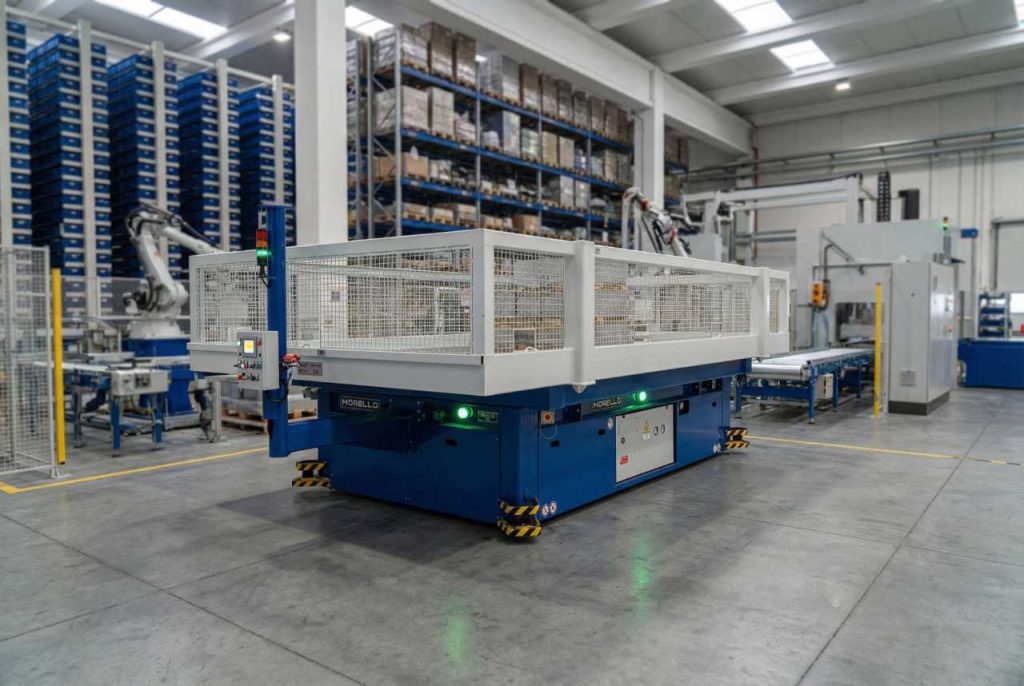
Automated guided vehicle sensors represent the cornerstone of modern AGV safety technology, transforming how heavy-duty materials are transported in industrial environments. When you’re moving loads that weigh several tons across factory floors, aerospace facilities, or wind energy installations, safety cannot be compromised.
Advanced sensor systems continuously monitor the surrounding environment, detecting obstacles, preventing collisions, and ensuring that both equipment and personnel remain protected throughout operations. These intelligent technologies work silently in the background, making split-second decisions that prevent accidents before they happen. From laser scanners that map every millimeter of space to ultrasonic sensors that function flawlessly in challenging conditions, AGV safety technology has evolved into a sophisticated network of protective measures. Understanding how these sensors operate and integrate into automated guided vehicles helps you make informed decisions about material handling solutions that prioritize both productivity and workplace safety in demanding industrial applications.
How automated guided vehicle sensors create protective barriers around your equipment
Think of automated guided vehicle sensors as an invisible shield that surrounds your material handling equipment, constantly vigilant and ready to respond. These sophisticated detection systems create multiple layers of protection around AGVs, monitoring every direction simultaneously to identify potential hazards before they become incidents. The technology works by establishing detection zones at varying distances from the vehicle—warning zones that trigger speed reduction, and critical zones that initiate immediate stops. When you’re transporting components for aircraft assembly or moving multi-ton wind turbine parts, this protective barrier becomes essential for operational continuity.
The intelligence behind AGV safety technology lies in its ability to distinguish between stationary infrastructure and unexpected obstacles. Your automated guided vehicle doesn’t simply detect objects; it analyzes movement patterns, calculates trajectories, and predicts potential collision points. In aerospace manufacturing facilities where precision components worth millions move through production areas, these sensors ensure that human workers, stationary equipment, and other vehicles never interfere with transport operations. The system continuously adjusts the protective barrier based on vehicle speed, load weight, and environmental conditions, creating a dynamic safety envelope that adapts in real-time to changing circumstances around your heavy-duty transport equipment.
Laser scanning systems: precision detection for collision-free operations
Laser scanning technology represents the gold standard in automated guided vehicle sensors, delivering millimeter-level accuracy across detection fields that span several meters. These systems emit concentrated light beams that sweep horizontally across the vehicle’s path, creating a detailed map of the surrounding environment hundreds of times per second. When the laser encounters an object—whether it’s a support column, a parked forklift, or a person crossing the transport path—the reflected beam returns to the sensor, where sophisticated algorithms calculate exact distance and position.
What makes laser scanners particularly valuable in heavy-duty applications is their configurable detection fields. You can program multiple protection zones with different sensitivity levels: a warning field that slows the vehicle when objects enter a predefined perimeter, and a safety field that triggers immediate stopping when obstacles breach the critical threshold. In military equipment manufacturing, where AGVs transport sensitive defense components through secure facilities, laser scanning systems provide the reliability necessary for round-the-clock autonomous operations. The technology functions effectively across distances up to thirty meters, giving your automated vehicles sufficient reaction time even when carrying loads with significant momentum. Unlike vision-based systems that struggle with varying light conditions, laser scanners maintain consistent performance regardless of ambient lighting, making them ideal for facilities operating multiple shifts.
Ultrasonic sensor integration in AGV safety systems for challenging environments
Ultrasonic sensors complement laser systems by addressing specific environmental challenges that heavy industrial settings present. These devices emit high-frequency sound waves that bounce off surfaces and return to the sensor, measuring distance based on travel time. The real advantage emerges in conditions where dust, steam, or airborne particles would interfere with optical detection methods. When your AGVs operate in steel fabrication areas, foundries, or outdoor wind energy component yards, ultrasonic sensors maintain reliable detection capabilities where laser systems might experience reduced effectiveness.
The acoustic nature of ultrasonic technology provides unique benefits for close-range detection scenarios. These sensors excel at identifying objects within immediate proximity to the vehicle—typically within five meters—making them perfect for precise docking operations and tight maneuvering situations. In aerospace component storage facilities where AGVs must navigate between closely spaced inventory racks, ultrasonic sensors detect subtle movements and provide continuous feedback for safe positioning. The technology also proves cost-effective for comprehensive coverage, allowing you to install multiple sensors around the vehicle perimeter without significant budget impact. Modern AGV safety technology often combines ultrasonic sensors with laser scanners, using acoustic detection for rear and side monitoring while reserving laser systems for forward-facing, long-range obstacle detection in your material handling operations.
Multi-sensor coordination: building comprehensive safety networks for heavy-duty transport
The most effective AGV safety systems don’t rely on a single sensor type but instead integrate multiple detection technologies into a coordinated network. This multi-layered approach combines the long-range precision of laser scanners with the environmental resilience of ultrasonic sensors, creating redundant safety mechanisms that ensure protection even if one system experiences temporary interference. Your automated guided vehicle processes data from all sensors simultaneously, using advanced algorithms to create a unified understanding of its surroundings and make intelligent navigation decisions.
Consider how this integration functions when an AGV transports a twenty-ton aircraft fuselage section through a busy manufacturing floor. Laser scanners monitor the forward path across a wide detection field, identifying obstacles fifteen meters ahead and calculating optimal speed adjustments. Simultaneously, ultrasonic sensors track the sides and rear, detecting personnel who might approach the vehicle from blind spots. Bumper-mounted contact sensors provide a final failsafe layer, triggering immediate stops if physical contact occurs despite the electronic detection systems. This sensor fusion creates a comprehensive safety envelope where each technology compensates for the limitations of others. The system continuously validates data across multiple inputs—if laser detection indicates a clear path but ultrasonic sensors detect nearby movement, the vehicle adopts the more conservative response, prioritizing safety over speed in your heavy-duty transport operations.
Implementing advanced sensor solutions in your material handling operations
Selecting appropriate automated guided vehicle sensors requires careful analysis of your specific operational environment and transport requirements. Start by mapping your facility layout, identifying areas with challenging conditions—narrow passages, blind corners, high-traffic intersections, or zones with environmental factors like dust or variable lighting. Different sectors demand tailored sensor configurations: aerospace facilities handling delicate components benefit from extended detection ranges that prevent sudden stops with fragile loads, while military equipment manufacturing requires sensor systems with enhanced security features and fail-safe redundancy.
The integration process extends beyond simply installing sensors on vehicles. Your AGV safety technology must communicate with facility infrastructure, connecting to traffic management systems that coordinate multiple vehicles, emergency stop networks, and facility monitoring platforms. Modern sensor systems generate valuable operational data—tracking near-miss incidents, identifying frequently congested areas, and monitoring system performance over time. This information helps you optimize facility layouts, adjust traffic patterns, and schedule preventive maintenance before sensor degradation affects safety. When you’re investing in heavy-duty material handling solutions capable of moving loads exceeding fifty tons, the sensor technology protecting those operations deserves the same careful consideration as the vehicle’s structural capacity and power systems.
Securing your heavy-duty operations with intelligent sensor technology
Advanced automated guided vehicle sensors transform your material handling operations from reactive to predictive, preventing incidents before they occur rather than responding after accidents happen. The integration of laser scanning precision, ultrasonic reliability, and coordinated multi-sensor networks creates transport systems capable of moving multi-ton loads with confidence across demanding industrial environments. Whether you’re handling aerospace components, military equipment, or wind energy installations, AGV safety systems provide the protective intelligence necessary for continuous, autonomous operations that protect both personnel and valuable cargo.
Morello’s AGV automated guided carts incorporate sophisticated sensor systems designed specifically for heavy-duty applications where safety and reliability cannot be compromised. Our engineering team works with clients worldwide to configure sensor solutions that match your facility’s unique operational challenges, ensuring that your material handling equipment delivers both productivity and protection in equal measure.